An air bubble under press-on nails is air that got trapped between your own nail and the set the moment you glued it on. It is almost never a bad set that is the problem, it is one movement in the application that went too fast.
I get them most often on my thumbs, and nearly always the times I have been in a hurry and pressed the tip down first. That pale, slightly grey patch in the middle of the nail is air, not glue.
Here is what it means, what to do about it now, and how to skip it next time.
What an air bubble under press-on nails looks like
An air bubble looks like a pale, slightly grey or matte patch under the nail, usually right in the middle where the nail curves the most. Press on it gently and it feels hollow, while the rest of the nail sits down the way it should.
There are two kinds, and they do not mean the same thing.
- Small and sealed. The bubble sits in the middle of the nail and the edges all around are pressed down. That one is mostly a looks problem, and the set will last its full life anyway.
- Open to an edge. The bubble reaches out to the side or toward the tip, and there is a gap there. Now water gets in, and it is on its way to becoming a nail that lifts.
The difference between the two decides what you do, so it is worth a look before you make up your mind. A bubble you can barely see and cannot feel at the edge, you leave alone.
Why the air bubble forms
The bubble comes from the application, not from the glue. Four things cause it, and they tend to show up together.
- You pressed the tip down first. Lay the nail down tip first and push backwards, and you leave a little pocket of air in the middle. The air has no way out.
- Too much glue. A big blob pools and pushes air ahead of it as you press. Spread thin and even, it lies flat instead.
- Moisture or oil in the middle. If the nail is not fully dry and degreased where it curves the most, the glue does not grip right there, and you get a void.
- You let go too early. Let go before the whole nail has made contact and the middle springs back up while the glue is still wet.
Here is the thing: it is not the glue, it is the prep and that one movement. How to get a set to hold from the first press is something I have written more about in the guide on getting press-on nails to last all week, and most of it applies here too.
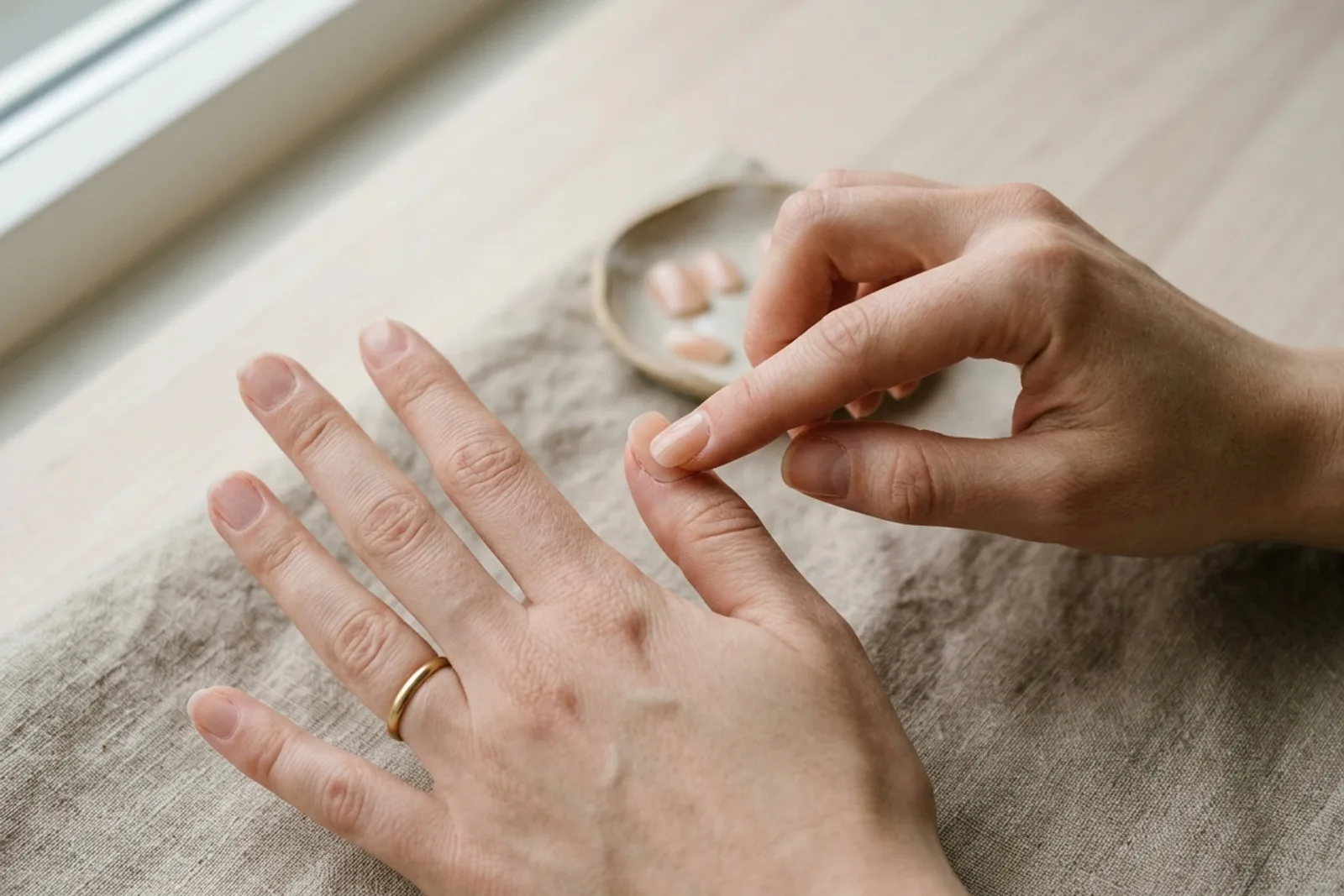
What to do about an air bubble now
If the bubble is small and the edges sit down, leave it. It is mostly cosmetic, and you do more harm than good picking at a nail that otherwise sits well. Never try to press a bubble out after the glue has dried, because the air is locked in and all you achieve is loosening more of the nail.
If the bubble reaches an edge, take that one nail off and put it back on. Rest the finger in a little warm soapy water for a few minutes until that nail lets go, dry it completely, and reglue with a thin layer. You do not need to take off the whole set for one nail.
Do not use acetone for this. It dries the nail out and makes it brittle, and you do not need it when warm water loosens the one nail perfectly well.
The most important part is this: a bubble that lets water in is where the trouble starts, so do not glue over it and hope. Water and a little warmth under a nail are exactly the conditions bacteria like. If the nail under the bubble looks white, sore or discoloured, do not glue over it again. Let it grow out, and ask a pharmacist or a doctor if it does not get better. A bubble that grows and grips worse by the day is the same thing as when press-on nails lift at the edge, just a bit further in on the nail.
How to avoid air bubbles next time
Almost all of it comes down to the seconds while you glue it on. Here is how I do it when I want it even:
- Wipe the nail with a little rubbing alcohol and let it dry completely. Dry nail, always.
- Use a thin layer of glue, not a blob. Less than you think.
- Set the nail down from the cuticle at a slight angle, and roll it forward toward the tip so the air is pushed out ahead of you.
- Hold for 20 to 30 seconds, and press gently from the middle outward while you hold.
- Pick a size that follows the curve of your own nail. A too-flat nail on a curved thumb makes a pocket of air no matter how well you glue.
The rest of what decides whether a set stays, from the right size to the application itself, is in our big guide to press-on nails.
A small note that belongs here: this site is run by X Beauty AB, which also runs the shop xnails.no, so we sell both glue and tabs ourselves. That is why we say it out loud before we recommend a method. If you want to skip the glue entirely, adhesive tabs give a flatter, more even contact with fewer bubbles, but they hold for a shorter time. It is a trade-off, not a rule.
Questions we get about air bubbles
Can I press the air bubble out after the glue has dried?
No. Once the glue has set, the air is stuck, and if you press hard enough to move it you only loosen the nail from the edges. If you want rid of a bubble that bothers you, take that one nail off and put it back on.
Is an air bubble bad for the nail underneath?
A small, sealed bubble does no harm and goes away with the set. One that is open to an edge lets water in, and then you should take the nail off before it becomes a loose nail. If the nail underneath looks sore or discoloured, keep it bare and ask a pharmacist or a doctor.
Why do I get air bubbles only on my thumbs?
The thumb is the most curved nail you have, and a flat press-on set fits worst right there. If you get bubbles only on your thumbs, it is usually the size and the curve that do not match, not the way you glue.
Do adhesive tabs help against air bubbles?
Often yes. A tab lies flat against the whole nail and has no blob to push air ahead of it, so you get bubbles less often. In return, tabs hold for a shorter time than glue, so it depends on how long the set needs to stay on.
If you take one thing from this: lay the nail down from the cuticle and roll forward toward the tip, instead of pressing the tip down first. Nearly every air bubble I have had came from that one shortcut. If your nail is very curved on the thumbs, tabs can be easier than glue right there.